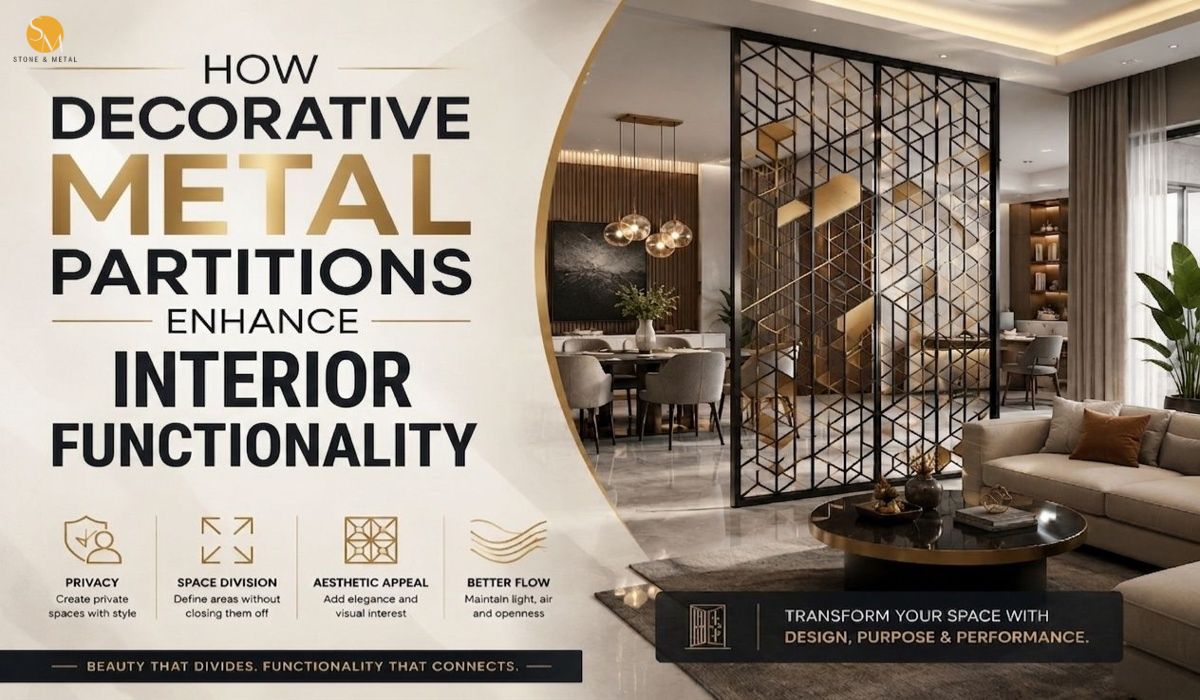
Interior spaces today are expected to deliver more than visual appeal. They must balance privacy, openness, organization, and flexibility without compromising design flow. This is why decorative metal partitions have become an increasingly popular solution in modern interior planning.
Unlike traditional solid dividers, decorative partitions help define spaces while maintaining natural light, ventilation, and visual connectivity. Their ability to combine structure with design makes them ideal for both residential and commercial environments where functionality and aesthetics must work together.
From luxury homes to offices and hospitality spaces, architectural metal partitions are transforming how interiors are designed. With custom fabrication and modern detailing options, these partitions create practical space division while enhancing the overall sophistication and usability of interior environments.
Interior design has evolved beyond simply dividing spaces with walls and fixed structures. Modern interiors now prioritize openness, flexibility, and visual continuity, which is why decorative metal partitions are becoming a preferred solution for contemporary design projects.
Unlike conventional partitions, decorative metal solutions provide structured separation without making a space feel confined. They allow designers to create functional boundaries while preserving light flow and maintaining an open, connected atmosphere.
Emerging interior design trends show a strong shift toward adaptable design elements that combine practicality with aesthetic sophistication.
These partitions are especially valuable because they support:
The growing demand for adaptable interior solutions has made decorative metal partitions an essential design feature for architects and interior specialists seeking functionality without sacrificing style.
As interior spaces continue to evolve, decorative partitions are redefining how layouts are structured, making them a smart choice for modern design execution.
Effective space planning is essential for creating interiors that are both practical and visually balanced. Decorative metal partitions play an important role in achieving this by helping define separate areas without disrupting the overall openness of a space.
Unlike traditional walls, metal partitions allow spaces to remain connected while serving different functional purposes. They help organize layouts more efficiently by creating subtle divisions that support privacy, movement, and visual flow.
Modern metal partition systems offer flexible design possibilities that can be adapted to various interior requirements, making them highly effective for both residential and commercial applications.
One of the greatest advantages of decorative partitions is their ability to create separation while preserving openness.
This allows interiors to benefit from:
This approach is especially valuable in open-plan interiors where maintaining connection between spaces is important, but functional distinction is still required.
By improving layout efficiency without creating physical heaviness, decorative partitions help maximize interior usability while supporting a refined and modern design language.
One of the biggest challenges in interior design is creating privacy without making a space feel enclosed. Decorative metal partitions solve this challenge by offering selective separation that maintains openness, light flow, and visual connectivity.
Traditional solid walls often block natural light and create a sense of confinement. In contrast, decorative metal screens provide privacy while allowing interiors to feel breathable and spacious. This makes them ideal for spaces that require both separation and openness.
Innovative partition applications demonstrate how metal partitions are being used to create balanced interior layouts across residential and commercial projects.
These partitions improve functionality by offering:
Feature | Solid Walls | Metal Partitions |
Light Flow | Restricted | Preserved |
Visual Openness | Low | High |
Flexibility | Fixed | Adaptable |
Aesthetic Value | Functional only | Decorative + Functional |
Space Efficiency | Lower | Higher |
This balance between privacy and openness makes decorative metal partitions an ideal solution for modern interiors where functionality must support both comfort and visual appeal.
By preserving openness while improving zoning, metal partitions create interiors that feel organized, elegant, and more adaptable to changing needs.
Beyond functionality, decorative metal partitions play a major role in elevating the visual appeal of interior spaces. Their intricate detailing, clean lines, and customizable patterns make them a strong architectural feature that enhances the overall character of an interior.
Unlike plain dividers, decorative partitions introduce texture, depth, and artistic definition to a space. They can be designed to complement modern, contemporary, industrial, or luxury interiors while maintaining a seamless connection with the overall design language.
Advanced design solutions allow architects and interior designers to create partitions that align perfectly with the visual goals of each project.
Decorative partitions enhance interiors through:
Their ability to function as both a practical divider and a decorative feature makes them highly versatile in interior applications.
When integrated thoughtfully, decorative metal partitions transform ordinary layouts into visually refined spaces that deliver both elegance and functionality.
The effectiveness of decorative metal partitions depends greatly on how accurately they are designed and manufactured. While standard ready-made options may offer basic functionality, custom fabrication delivers the precision and flexibility needed for superior interior performance.
Every interior space has unique dimensions, design requirements, and functional goals. Custom fabrication ensures that partitions are created specifically for these conditions, resulting in a better fit, stronger visual integration, and improved overall usability.
Detailed partition concepts show how tailored fabrication improves both structural precision and design adaptability.
Custom fabrication offers advantages such as:
Design Need | Standard Partition | Custom Fabrication Benefit |
Space Fit | Limited adaptability | Precise alignment |
Design Options | Restricted | Fully customizable |
Installation | Requires adjustment | Seamless integration |
Visual Consistency | Generic appearance | Project-specific finish |
Functional Performance | Moderate | Optimized |
Custom fabrication allows designers to create partitions that do more than divide space they become integrated architectural elements that improve layout performance and design quality.
This precision makes decorative partitions more effective as long-term interior solutions that combine function, flexibility, and visual refinement.
One of the biggest advantages of decorative metal partitions is their adaptability across different interior settings. Their combination of functionality, durability, and visual sophistication makes them suitable for a wide range of environments where efficient space division is essential.
In residential interiors, decorative partitions are commonly used to separate living and dining spaces, define entry zones, or create semi-private areas without disrupting openness. They help improve layout organization while adding elegance to the overall design.
Inspiration from completed project gallery examples shows how these partitions can be customized for different functional and aesthetic requirements.
They are equally effective in commercial environments such as:
In these settings, metal partitions help create structure, improve movement flow, and support modern branding aesthetics.
Their versatility allows designers to tailor partition designs to suit both practical requirements and architectural identity. Whether used for subtle zoning or as a bold design feature, decorative partitions enhance usability across diverse interior applications.
This multi-environment adaptability makes them a practical and valuable solution for modern interior planning.
Interior design decisions should deliver value beyond immediate aesthetics. Decorative metal partitions stand out as a long-term investment because they combine durability, flexibility, and timeless design functionality.
Unlike temporary dividers or conventional partition systems that may require replacement or redesign over time, metal partitions are built for long-term performance. Their structural strength and resistance to wear make them suitable for spaces that demand consistent functionality.
Practical project insights show how thoughtfully designed partition systems continue to add value through improved usability and design longevity.
The long-term value of decorative partitions comes from their ability to support multiple interior goals simultaneously.
They offer:
This balance makes them particularly effective for interiors that may evolve over time while still requiring consistent spatial functionality.
For architects, designers, and property owners, decorative metal partitions are more than design enhancements. They are strategic interior solutions that improve usability, preserve aesthetic value, and deliver lasting performance.
Their ability to combine beauty with durability makes them a smart investment for future-ready interior environments.
Creating interiors that balance privacy, openness, and design sophistication requires solutions that are both practical and visually refined. Decorative metal partitions offer the perfect combination of space optimization, architectural elegance, and long-term durability for modern interior environments.
Whether you are designing residential spaces, commercial interiors, or luxury architectural projects, professionally crafted partition systems can help you achieve better functionality without compromising design flow.
Explore tailored partition solutions designed to match your interior vision and functional requirements. Contact Us
Decorative metal partitions are custom-designed divider structures used to separate spaces while maintaining visual openness, light flow, and architectural appeal.
They help define spaces, improve layout organization, create privacy, and maintain airflow and visual connectivity within interiors.
They can be used in homes, offices, hotels, restaurants, retail spaces, reception areas, and other commercial interiors.
Yes, in many modern interiors, they offer better flexibility, improved openness, aesthetic value, and space efficiency compared to solid walls.
Yes. They offer partial screening that creates privacy while still allowing light and ventilation to pass through.
Common materials include stainless steel, mild steel, aluminium, brass, and powder-coated metal finishes.
Yes. Custom fabrication allows partitions to be tailored in size, pattern, finish, and design to match specific project requirements.
Yes. High-quality metal partitions are highly durable, low-maintenance, and designed for long-term structural performance.
Yes. They are especially useful in smaller interiors because they create functional separation without making spaces feel enclosed.
They combine functionality, flexibility, visual sophistication, and architectural detailing, making them ideal for contemporary interior spaces.